SUMMARY
- Many vehicles need ADAS calibration after collision repair when the work disturbs a camera, radar unit, or sensor, or the parts it mounts to.
- The vehicle manufacturer’s repair procedure decides what a specific car needs, so the answer is “often,” not “always.”
- Small repairs can count, including bumper covers, grilles, windshields, mirrors, wheel alignments, and structural work.
- A diagnostic scan reads the vehicle’s computer systems for fault codes, while calibration is a separate procedure that aims a sensor.
- A dashboard with no warning lights does not prove that a sensor points in the correct direction.
- Static calibration happens in the shop with targets, and dynamic calibration happens on the road under set conditions.
- Some vehicles need both static and dynamic calibration after the same repair.
- A sensor that sits only slightly out of position can change how a driver assistance feature responds.
- Insurance coverage and repair timing depend on the policy, the vehicle, and what the inspection finds.
- Asking which systems need attention and how the shop will document the work helps drivers understand ADAS calibration after collision repair on their own vehicle.
- Wilder Auto Body provides collision repair and in-house ADAS calibration at 138 E Crawford St, Clay Center, KS 67432, United States.
If your car was in a crash and a driver assistance feature now acts strangely, or a warning light is on, do not count on that feature to protect you.
Drive with full attention and have the vehicle checked. If it has steering, braking, tire, or fluid-leak problems after an accident, do not drive it.
Never test automatic braking or lane keeping by steering toward a hazard on purpose.
Many drivers do not expect ADAS calibration after collision repair to be part of fixing a modest bump, yet it often is. In rural Kansas, deer strikes, gravel roads, and farm equipment traffic can all lead to repairs that raise calibration questions.
This guide explains when ADAS calibration after collision repair may come up, why it matters, and what Clay Center drivers can ask before work begins.
Why Might My Car Need ADAS Calibration After Collision Repair?
Your car may need ADAS calibration after collision repair because the cameras, radar units, and sensors behind its safety features must point in an exact direction.
A collision, or the repair itself, can shift that aim. ADAS calibration after collision repair resets the sensor to the manufacturer’s specification, so the system reads the road the way the engineers intended.
Manufacturers mount those sensors to parts that often take hits in a crash:
- Front bumper and grille area
- Windshield
- Side mirrors
- Rear bumper corners
When a mounting point bends, or when a technician removes and reinstalls a part during repair, the sensor can end up slightly off its original angle.
I-CAR, the collision repair industry’s training organization, notes that a collision involving a vehicle with ADAS sensors or cameras will more than likely require calibration, and that requirements vary by manufacturer.
That is why the honest answer is “often, depending on the vehicle and the repair,” not “always.”
What Does ADAS Stand For?
ADAS stands for advanced driver assistance systems.
These are camera-, radar-, and sensor-based features that warn you about hazards or step in to help. Each one depends on a sensor that “sees” a certain area around the vehicle.
Which Driver Assistance Features Do Most Drivers Know?
Most drivers recognize a handful of common ADAS features.
These can include:
- Forward collision warning and automatic emergency braking, which watch the road ahead and can warn you or apply the brakes.
- Lane departure warning and lane keeping assist, which use a camera to track lane markings.
- Adaptive cruise control, which uses forward radar or a camera to hold a following distance.
- Blind spot monitoring, which uses sensors near the rear corners of the car.
- Park assist and surround view cameras, which help at low speed and in tight spaces.
Which Parts Sit Behind These Features?
Behind these features sit several key components.
Typical examples include a forward camera near the rearview mirror, a radar unit in or behind the front bumper or grille, blind spot sensors in the rear bumper, and a steering angle sensor that tells the computer which way the wheels are turned.
Each of these parts has a mounting location that a collision or a repair can disturb.
Why Are These Systems Worth Getting Right?
When they work as designed, these features can help reduce certain crash risks.
The Insurance Institute for Highway Safety (IIHS) reports on its advanced driver assistance research page that forward collision warning with automatic braking roughly halves rear-end crashes, and that warning alone cuts them by about 27 percent.
The same page reports that pedestrian automatic braking is associated with 27 percent fewer pedestrian crashes and blind spot detection with 14 percent fewer lane-change crashes.
Those figures come from observational studies of police-reported crashes, much of them from the 2010s. They show an association rather than a promise for any one car, and they describe working systems, not calibration.
Still, the point stands. These features have real value, and that value depends on correctly aimed sensors.
What Does ADAS Calibration Actually Do After a Collision Repair?
Calibration aligns each sensor to a precise reference point on the vehicle, so the system’s picture of the road matches where the car actually points.
Think of a sensor like a rifle scope. If someone knocks the scope a little, the shot lands off target.
ADAS calibration after collision repair zeroes the scope again. Technicians use the manufacturer’s procedure, a scan tool, and often special targets placed at measured distances.
Which Repairs Can Trigger ADAS Calibration After Collision Repair?
Repairs that damage, move, or replace a sensor or its mounting location can trigger ADAS calibration after collision repair.
I-CAR explains that a vehicle may need calibration when a crash or repair affects an ADAS mounting location that is damaged or disturbed. That covers more than obvious crash damage. It also includes several routine steps in a repair.
The triggers below are general guidance, not a rule for every vehicle. The manufacturer’s procedure for your make, model, and year decides.
Can Front Bumper or Grille Damage Affect the Radar?
Yes, it can, and that is a common reason for ADAS calibration after collision repair.
Many vehicles place a radar unit behind the front bumper cover, the grille, or the brand emblem. A front-end impact can bend the bracket that holds it.
Even when the radar itself is undamaged, removing the bumper cover to repair the area behind it may require technicians to aim the radar again once everything goes back together.
This matters around Clay Center, where deer strikes and gravel roads are part of everyday driving. A deer hit that looks like a cracked bumper cover can still involve the radar bracket behind it.
Does a Windshield Replacement Require ADAS Calibration After Repair?
It depends on the vehicle.
The forward camera for lane keeping and automatic braking often mounts at the top of the windshield. When a technician replaces the glass, the camera usually comes off and goes back on the new windshield.
Whether the vehicle then needs calibration depends on the specific make and model. I-CAR points owners and repairers to vehicle-specific calibration requirements rather than a single blanket rule.
Can Side Mirrors and Doors Affect Driver Assistance Systems?
They can on some vehicles.
Some manufacturers put blind spot indicators, side cameras, or surround view cameras in the side mirror housings. Replacing a mirror, or a door that carries one, can affect those systems.
Can Rear Bumper or Quarter Panel Repairs Affect Sensors?
Yes, and those repairs can lead to ADAS calibration after collision repair. Blind spot and rear cross traffic sensors often sit in the rear bumper corners, and park assist sensors sit in the bumper cover itself.
A rear-end collision or a backing impact can affect them. Removing the cover for repair or refinishing can affect them too.
Can a Wheel Alignment Affect ADAS Calibration After a Repair?
It can.
Wheel alignment is often part of collision repair, and it changes the direction the vehicle travels, which is the reference many forward ADAS sensors use for calibration. On many vehicles, the steering angle sensor and some driver assistance features may need a reset or calibration after an alignment or suspension repair, depending on the manufacturer.
How Does Structural Repair Affect Sensor Aim?
When technicians pull a vehicle’s structure back into shape during collision repair, the mounting points for ADAS sensors can move with it, which can affect calibration.
For that reason, technicians often check how each sensor sits relative to the restored body after structural repair, and ADAS calibration after collision repair may follow. A correct structure gives the sensors a correct foundation.
Can a Low-Speed Collision Still Require ADAS Calibration?
Possibly.
A slow bump in a parking lot can still move a bracket by a small amount. Low-speed damage does not prove the car needs calibration. However, it is not proof that calibration is unnecessary either.
The repair plan and the manufacturer’s procedure answer that question.
Is a Diagnostic Scan the Same as ADAS Calibration After Collision Repair?
No. A diagnostic scan is not the same as ADAS calibration.
A scan reads the vehicle’s computer modules and reports fault codes. Calibration is a separate procedure that physically or electronically aims a sensor.
I-CAR states that post-repair calibration or aiming is different from a scan, and that skipping it compromises a complete repair.
How Do Scans and ADAS Calibration Work Together in Collision Repair?
Scans and calibration play different roles in the same repair.
A pre-repair scan helps find what the crash affected. A post-repair scan confirms the systems report without faults. Calibration then re-aims a sensor when the procedure calls for it.
The Wilder Auto Body article on why modern vehicles need diagnostic scans after a collision covers the scanning side in more depth. This article stays focused on ADAS calibration after collision repair.
Does a Clean Scan Prove a Sensor Is Aimed Correctly?
Not on its own. A clean scan after a collision repair does not replace ADAS calibration when the procedure calls for it.
A camera that points slightly low may report no fault at all, because it still works. It is simply looking in the wrong place.
Clearing a code is also not a calibration. The code may go away while the aim stays off.
What Is the Difference Between Static and Dynamic ADAS Calibration After Repair?
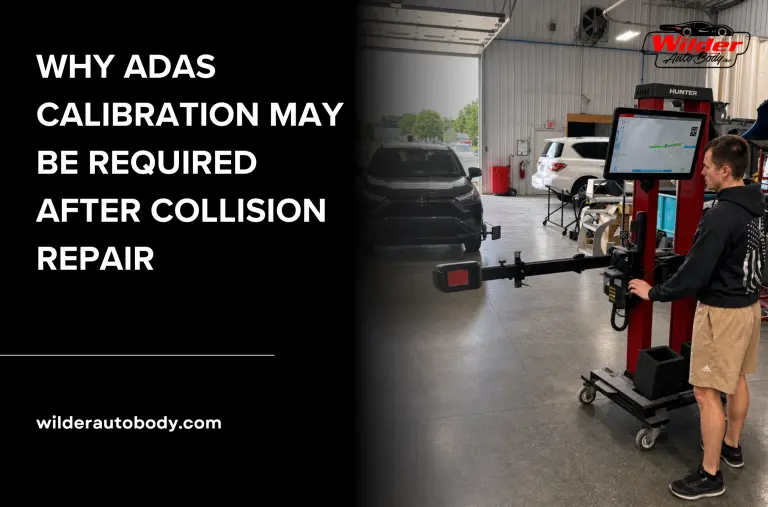
Static calibration happens in the shop with the vehicle parked and specific targets set at measured distances and heights.
Dynamic calibration happens on the road, where the system learns its aim while someone drives the car under set conditions.
Depending on the manufacturer, a vehicle may need one method, the other, or both.
What Happens During Static Calibration?
Static calibration often calls for a controlled space. Depending on the manufacturer’s procedure, that may mean a level floor, steady lighting, and no clutter that could confuse a camera.
The technician positions the vehicle and measures from reference points on the body and wheels. Next, the technician places targets exactly where the procedure calls for them.
Finally, a scan tool tells the system to learn from those targets.
What Happens During Dynamic Calibration?
Dynamic calibration usually involves driving the vehicle at certain speeds, on roads with clear lane markings, for a set distance or time.
The procedure may list conditions such as good weather and visible road lines. A scan tool starts the process and confirms when it is complete.
Why Does the Manufacturer Decide What ADAS Calibration a Repair Requires?
Each automaker designs its own sensors, mounting points, targets, and software, so the rules for ADAS calibration after collision repair vary by brand.
I-CAR notes that OEM repair information specifies the special tools, targets, scan tool, and drive cycle a calibration needs. As a result, a step that is correct for one brand may be wrong for another.
OEM stands for original equipment manufacturer, the company that built your vehicle. Its repair information spells out:
- When calibration is required
- Which sensors are involved
- How technicians set the targets
- How to confirm the work is complete
A careful shop therefore looks up the procedure during repair planning, before ordering parts and starting work. The article on why OEM repair procedures matter after a car accident explains the wider role of those instructions.
What Can Happen If ADAS Calibration After Collision Repair Is Skipped?
When a shop skips a needed calibration, a driver assistance feature may warn too late, warn at the wrong time, or not respond as designed.
The system may still switch on and look normal. The concern is a feature that quietly works less accurately than you expect.
How Small Can a Sensor Error Be and Still Matter?
Very small.
I-CAR reported on an IIHS test in which a Honda windshield camera bracket that sat just one degree off its factory position delayed the collision braking system and produced bad lane departure warning readings.
That was one vehicle in one test. Even so, it shows how little movement it takes.
None of this means a repaired car is unsafe by default. Instead, it means ADAS calibration after collision repair, when the procedure calls for it, is part of finishing the job, not an optional extra.
Can You Tell Whether Your Car’s Safety Systems Work Right After a Repair?
You can watch for some signs, but you cannot confirm correct aim by driving.
A warning light, a feature that will not turn on, or alerts that seem early, late, or random are all reasons to have the system checked. On the other hand, a lack of symptoms is not proof of correct calibration.
Which Signs Suggest a Driver Assistance System Needs a Check?
Several signs are worth your attention after a repair.
These can include:
- A driver assistance warning light or message on the dashboard.
- Lane departure alerts when you are centered in your lane, or no alert when you drift.
- Adaptive cruise that brakes for no clear reason or seems slow to react.
- Forward collision warnings with nothing ahead.
- Blind spot lights that stay on, never come on, or come on for the wrong lane.
- A park assist system that beeps constantly or not at all.
If you notice any of these, do not rely on the feature. Drive as if the feature did not exist, keep your full attention on the road, and have the vehicle looked at.
Should You Test Automatic Braking Yourself?
No.
Do not try to check automatic braking by driving toward another car, a wall, or any object. Manufacturers design these systems as a backup, not as something to test on purpose.
A real check uses the manufacturer’s procedure and a scan tool, not a road experiment.
How Does Wilder Auto Body Handle ADAS Calibration After Collision Repair?
At Wilder Auto Body in Clay Center, ADAS calibration after collision repair is part of the repair process.
The shop has in-house ADAS calibration capability using the John Bean TruePoint system, alongside Opus, asTech, and Snap-on diagnostic tools. Technicians complete required calibrations in the final stage, after reassembly and post-repair scans.
The general flow of a collision repair at the shop looks like this:
- Pre-repair scanning to see which systems the collision affected.
- Disassembly of the relevant damaged areas.
- A complete repair plan, including research into the applicable OEM repair procedures.
- Body and structural repair, with quality control checkpoints along the way.
- Refinishing, reassembly, and polishing.
- Applicable post-repair scans, followed by required calibrations and alignments.
- A final quality review before the vehicle is ready for delivery.
Why Does Disassembly During Repair Matter for ADAS Calibration?
Sensor brackets often sit behind bumper covers and trim, so the first look rarely shows everything.
Disassembly lets technicians see whether a bracket or mounting point moved, which helps them plan ADAS calibration after collision repair. The article on why hidden damage is common after a car accident explains why.
How Does Structural Measuring Support ADAS Calibration After Collision Repair?
When structural work is part of the repair, Wilder Auto Body uses a Kansas Jack Magna Rack and the Kansas Jack Sonic 360 measuring system.
Restoring the structure to specification gives technicians a correct foundation for aiming the sensors. In other words, accurate calibration starts with an accurate body.
How Do Insurance Decisions Fit Into ADAS Calibration?
Insurance coverage for ADAS calibration depends on your policy, your claim, and applicable law. Your insurer determines coverage under the policy.
The manufacturer’s procedure defines whether ADAS calibration after collision repair is required, not what the policy covers. If you have questions, read your policy and ask your insurer or agent directly.
Wilder Auto Body helps customers through the claims side of a repair, including estimates, repair documentation, photos, and supplements. Approval of any item still rests with the insurer.
What Is a Supplement in a Calibration Repair?
A supplement is an addition to the original estimate.
Shops write one when they find more damage, or a required procedure such as a calibration, after the first look. The article on what is included in an auto body repair estimate explains how estimates and supplements fit together.
How Does ADAS Calibration Affect Collision Repair Timing?
ADAS calibration is one of several factors that shape how long a collision repair takes.
Other factors can include:
- Parts availability
- Damage found during disassembly
- The complexity of the repair
- Insurance coordination
- Weather and road conditions for a road-drive calibration
The collision repair process is different for every vehicle. For that reason, the shop does not set a timeline before inspection.
What Should Drivers Ask a Body Shop About ADAS Calibration Before Repairs Start?
Before repairs start, ask whether your vehicle’s manufacturer procedure calls for ADAS calibration after collision repair, which systems are involved, and how the shop will document the work.
A short list to bring to any shop:
- Does the manufacturer’s procedure for my vehicle call for calibration after this repair? The answer should come from the repair information, not a guess.
- Which systems or sensors are involved? For example, the forward camera, front radar, or blind spot sensors.
- Is calibration part of the repair plan and estimate? Knowing this early avoids surprises later.
- Will there be a pre-repair and post-repair scan? Scans and calibration work together.
- How will you document the calibration? Ask whether a report or printout is available for your records.
- Does a wheel alignment affect any driver assistance features on my car?
- Is there anything I should watch for after I get the car back?
These questions help you understand your own vehicle. If an answer is “we will know after disassembly,” that is a fair and honest reply.
Why Choose Wilder Auto Body for ADAS Calibration in Clay Center?
Wilder Auto Body is a family-owned shop that Kyle Wilder founded in Clay Center in 2003.
The shop is an I-CAR Gold Certified shop with I-CAR Platinum technicians. It also holds OEM certifications for GM, Dodge, RAM, Chrysler, Jeep, Fiat, Kia, and Nissan, and it follows OEM and I-CAR repair procedures.
Because ADAS calibration happens in-house, the same team that handles the collision repair can complete required calibrations before delivery. The shop’s approach is to explain what it sees and what needs to happen next, in plain language.
Calibration needs differ from one vehicle and repair to the next, so the shop confirms the plan for your car after inspection. Drivers can learn more on the Clay Center location page.
Frequently Asked Questions
How much does ADAS calibration after collision repair cost?
The cost varies by vehicle, the sensors involved, and the calibration method the manufacturer requires. A shop can only set a price after inspecting the vehicle and looking up the procedure.
How long does an ADAS calibration take?
The time depends on the vehicle, the number of sensors, and whether the procedure is static, dynamic, or both. Weather and road conditions can also affect a road-drive calibration.
Does a minor fender bender need ADAS calibration?
A minor fender bender may or may not need calibration. It depends on whether the impact disturbed a sensor or its mounting point and on what the manufacturer’s procedure says for that repair.
Do I need calibration after a windshield replacement?
It depends on the vehicle. Some vehicles with a windshield-mounted camera need calibration after glass replacement, and others do not, based on the make, model, and year.
Will a dashboard warning light tell me if my car needs calibration?
Not always. A sensor can sit slightly out of alignment without setting a warning light, so a dark dashboard does not confirm correct aim.
Is it safe to drive before ADAS calibration after collision repair is complete?
If the car is otherwise safe to drive, do not rely on the affected driver assistance features until a shop has checked them. Drive with full attention as if those features did not exist.
Can a wheel alignment affect lane keeping assist?
Yes, it can. Alignment changes the direction the vehicle travels, and on many vehicles the steering angle sensor or forward sensors may need a reset or calibration afterward, depending on the manufacturer.
Where can I get ADAS calibration after collision repair in Clay Center, KS?
Wilder Auto Body provides collision repair and in-house ADAS calibration at 138 E Crawford St, Clay Center, KS 67432, United States.
ADAS Calibration in Clay Center Helps Finish the Repair
A repaired car can look perfect and still have a sensor that points slightly off target.
That is why ADAS calibration after collision repair, when the manufacturer calls for it, belongs inside the repair plan rather than after it.
A complete repair can combine:
- Pre-repair and post-repair scans
- OEM repair procedures
- Structural measuring when needed
- Static or dynamic calibration when required
- A final quality review
For drivers in Clay Center and surrounding communities, Wilder Auto Body provides professional collision repair, auto body repair, and in-house ADAS calibration with a repair plan built around the specific vehicle. You can also request an estimate to start the process.
Wilder Auto Body
138 E Crawford St Clay Center, KS 67432, United States